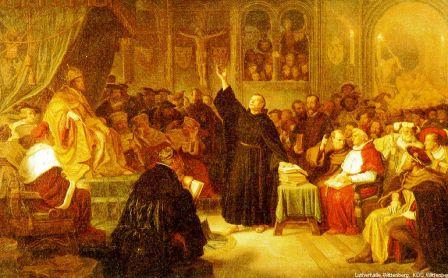
In remembrance of Reformation Day, Ligonier Ministries offers master storyteller Max Mclean's presentation of Martin Luther's famous "Here I Stand" speech. You can listen to it here.
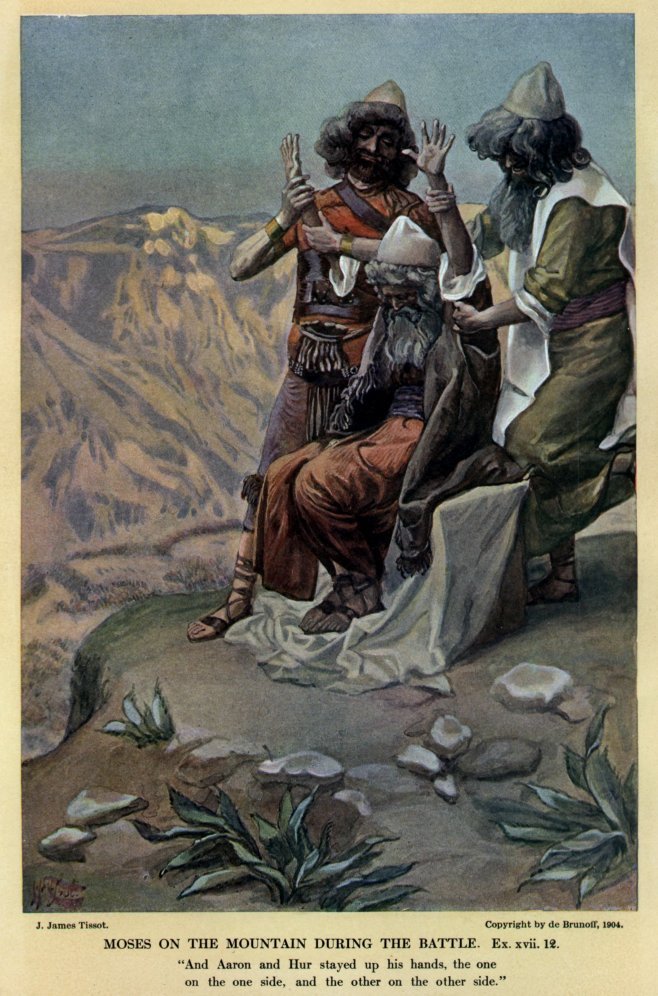
Churches may have committed people, competent programs and a comprehensive plan, but still fail to fulfill God's purpose. What is lacking? Concentrated Prayer! This sermon from Exodus 17:8-16 looks at why we should pray with fervor, with focus and with faithfulness.
MP3 File


"My conviction is that it is a very poor witness to have the house of believers blacked out on Halloween. Halloween presents a unique opportunity to interact with neighbors, to meet their children and to prove that Christians are part of the community and not merely people who want only to interact with Christian friends or to only interact in our own way and on our own terms."So in that spirit I say heartily "Happy Halloween!" And if you are in the neighborhood, stop on by. The light wil be on and the candy freely given. Just watch out for the Disney Pirate and the baby Tigger.
"Perhaps the greatest fallacy Christians believe about Halloween is that by refusing to participate in the day we are somehow taking a stand against Satan. And second to that, is that participation in the day is an endorsement of Satan and his evil holidays. The truth is that Halloween is not much different from any other day in this world where, at least for the time being, every day is Satan's day and a celebration of him and his power."
"I am guessing my neighbourhood is all-too-typical in that people typically arrive home from work and immediately drive their cars into the garage. More often than not they do not emerge again until the next morning when they leave for work once more. We are private, reclusive people who delight in our privacy. We rarely see our neighbors and rarely communicate with them. It would be a terrible breach of Canadian social etiquette for me to knock on a person's door and ask them for a small gift or even just to say "hello" to them. In the six years we have been living in this area, we have never once had a neighbor come to the door to ask for anything (except for this time). Yet on Halloween these barriers all come down. I have the opportunity to greet every person in the neighbourhood. I have the opportunity to introduce myself to the family who moved in just down the row a few weeks ago and to greet some other people I have not seen for weeks or months. At the same time, those people's children will come knocking on my door. We have two possible responses. We can turn the lights out and sit inside, seeking to shelter ourselves from the pagan influence of the little Harry Potters, Batmans and ballerinas, or we can greet them, gush over them, and make them feel welcome. We can prove ourselves to be the family who genuinely cares about our neighbours, or we can be the family who shows that we want to interact with them only on our terms. Most of our neighbors know of our faith and of our supposed concern for them. This is a chance to prove our love for them."
"The truth is that I have several convictions regarding Halloween. I despise the pagan aspects of it. I am convicted that my children should not dress as little devils or ghosts or monsters. But I am also convicted that there could be no worse witness to the neighbours than having a dark house, especially in a neighbourhood like ours which is small and where every person and every home is highly-visible. We know that, if we choose not to participate, the neighbors will notice and will smile knowingly, supposing that we feel too good to participate."
"My encouragement to you today is to think and pray about this issue. I do not see Halloween as a great evangelistic occasion. I do not foresee it as a time when the people coming to your door are likely to be saved. But I do think it is a time that you can prove to your neighbors that you care about them, that you care about their children, and that you are glad to be in this world and this culture, even if you are not of this world or this culture. Halloween may serve as a bridge to the hearts of those who live around you who so desperately need a Savior."

In Exodus 17, Moses celebrates the victory of Israel over the Amalekites by raising an altar to YHWH Nissi - God Is Our Banner. This message traces the concept of "banner" in the Scriptures and points us to Jesus as our call to battle, our strength in battle and our guaranteed victory in battle.
MP3 File
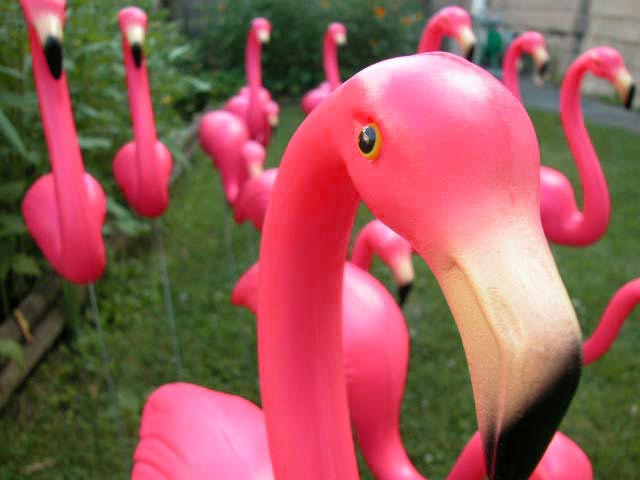
The pink plastic flamingo, a Florida-inspired icon that has been reviled as kitschy bad taste and revered as retro cool, is dead at age 49.
The pop culture symbol met its demise after its manufacturer, Union Products, of Leominster, Mass., was socked with a triple economic threat -- increases in costs of electricity and plastic resin combined with loss of financing. Production ended in June, and the plant is scheduled to close Nov. 1, according to president and CEO Dennis Plante...
Robert Thompson, professor of popular culture at Syracuse University, paid tribute to the infamous bird that has been immortalized everywhere -- from the John Waters' movie Pink Flamingos, to bachelor parties and lawns across America.
"Let's face it," he said. "As iconic emblems of kitsch, there are two pillars of cheesy, campiness in the American pantheon. One is the velvet Elvis. The other is the pink flamingo."
The birth of the plastic pink flamingo in 1957 coincided with the booming interest in Florida, Thompson said, making it possible for those in other parts of the country to have a little piece of the Sunshine State's mystique in their yard.
By the late '70s, according to Thompson, the pink flamingo became a symbol of bad taste. It was considered trash culture and embraced by folks with a wise-guy attitude. They knew better (wink, wink) but embraced the iconic symbol anyway.
By the late '80s and early '90s, he said we learned to make fun of pop culture items such as the pink flamingo as well as appreciate them.
"The pink flamingo has gone from a piece of the Florida boom and Florida exotica to being a symbol of trash culture to now becoming a combination of all we know -- kitsch, history, simplicity and elegance," Thompson said.
 Useless Information provides a little history about the birth of the Pink Flamingo:
The history of the pink flamingo can be traced back to 1946 when a company called Union Products started manufacturing “Plastics for the Lawn”. Their collection included dogs, ducks, frogs, and even a flamingo. But their products had one problem: They were only two-dimensional.For a delightfully weird retrospective view the short film: The Pink Flamingo: The Ambassador of the American Lawn.
In 1956, the Leominster, Massachusetts company decided to hire a young designer named Don Featherstone. Although Don was a serious sculptor and classical art student, his first project was to redesign their popular duck into the third dimension. (One must do what they can to pay the bills.) Don used a live duck as his model and after five months of work, the duck was retired to a local park.
His next project would prove to be his most famous. He couldn't get his hands on real flamingos, so he used photographs from a National Geographic in its place. He sculpted the original out of clay, which was then used to make a plaster cast. The plaster cast, in turn, was used to form the molds for the plastic. The original design called for detailed wooden legs, but they proved to be too costly and were replaced by the metal ones still seen today. While the exact date was never recorded, the first pink flamingo was born some time during 1957.
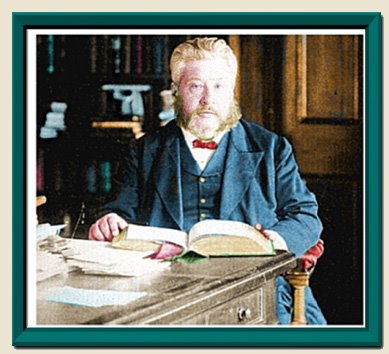
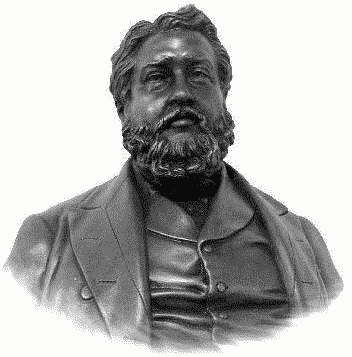 It is making light of the Gospel and of the whole of God’s glorious things, when men go to hear and yet do not attend. How many frequent churches and chapels to indulge in a comfortable nap! Think what a fearful insult that is to the King of Heaven. Would they enter into Her Majesty’s palace, ask an audience and then go to sleep before her face? And yet the sin of sleeping in Her Majesty’s presence would not be so great, even against her laws, as the sin of willfully slumbering in God’s sanctuary.
 "My guess is that our next Great Awakening will begin among college students. College students today are (spiritually speaking) the driest timber I have ever come across. Mostly they know little or nothing about religion; little or nothing about Americanism. Mostly no one ever speaks to them about truth and beauty, or nobility or honor or greatness. They are empty--spiritually bone dry--because no one has ever bothered to give them anything spiritual that is worth having. Platitudes about diversity and tolerance and multiculturalism are thin gruel for intellectually growing young people.

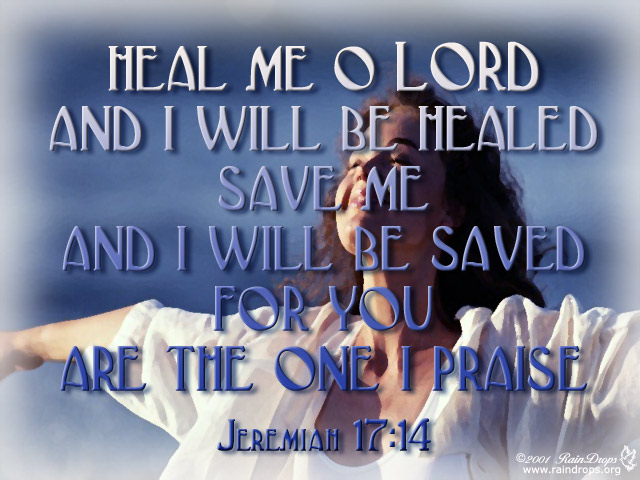
In this message from the series on the Names of God, we look at YHWH Rapha - The God who heals. From Exodus 15:22-26 we consider how God heals the sin-sickness of our bodies, minds and souls. We can rejoice because the cross of Christ heals the bitter waters of life.
MP3 File
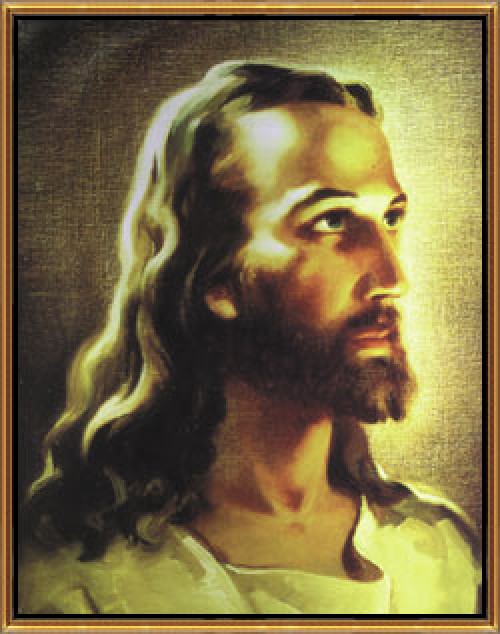 David Morgan gives us the story behind the face in this article from Christian History:
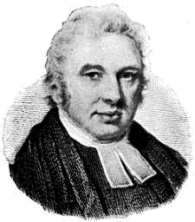 "Religion is not merely an act of homage paid upon our bended knees to God; it is not confined to the closet and the church, nor is it restrained to the hours of the sabbath; it is a general principle extending to a man’s whole conduct in every transaction and in every place. I know no mistake which is more dangerous than that which lays down devotional feelings alone as the test of true religion . . . Let us be convinced that all prayer, all preaching, all knowledge, are but means to attain a superior end; and that end the sanctification of the heart and of all the principles on which we are daily acting. Till our Christianity appears in our conversation, in our business, in our pleasures, in the aims and objects of our life, we have not attained a conformity to the image of our Saviour, nor have we learned His Gospel aright."